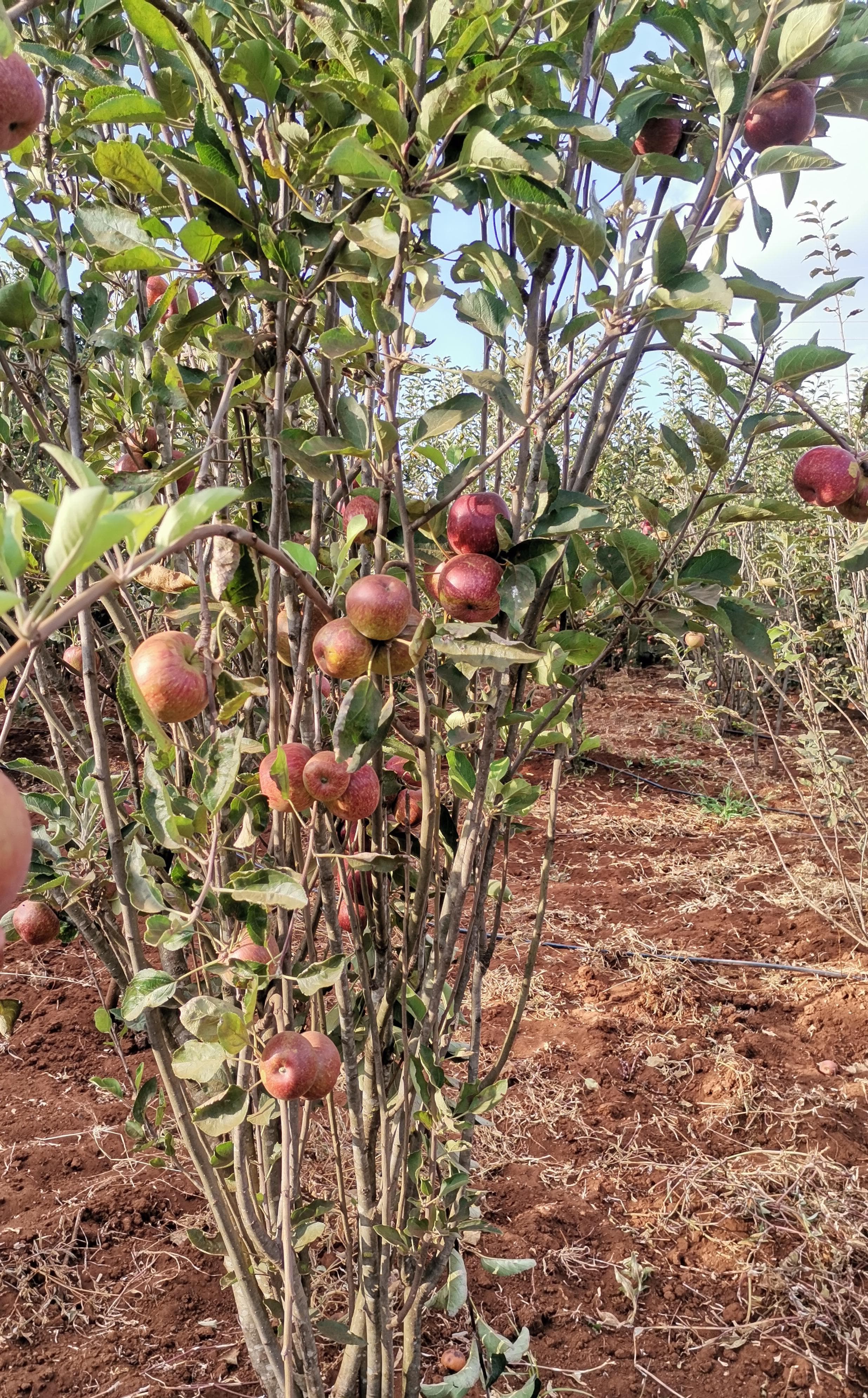
The Great East African Apple Conspiracy: Why You Should Be Growing Your Own Fruit
The Great East African Apple Conspiracy
If you grew up anywhere in East Africa, you were probably told a very specific, undeniable truth by your primary school science teacher, your grandparents, and the local greengrocer: “Apples do not grow here. They need snow. They need winter. They belong in storybooks and expensive imported cardboard boxes from South Africa.” For decades, the apple was the ultimate symbol of imported luxury. It was the fruit you only got when you were desperately sick, or when a very wealthy relative came to visit from the city. But what if I told you that everything you knew about apples in Africa was a complete and utter lie? Welcome, my friends, to the magical, slightly rebellious world of Grafted Apple Seedlings.
There is something profoundly satisfying—subversive, even—about walking out into your own backyard in Kiambu, or the highlands of Fort Portal, or the breezy slopes of Arusha, and plucking a crisp, red, perfectly sweet apple right off a tree that you planted yourself. It feels like you’re breaking a fundamental law of nature. It feels like you’ve outsmarted the universe. And thanks to the modern miracles of agricultural grafting, you absolutely have.
At Ziva Landscaping Co., we believe that your outdoor space shouldn’t just look aggressively beautiful; it should also work aggressively hard for you. This is the core philosophy of "edible landscaping." Why plant an ornamental tree that just drops useless leaves all over your newly perfectly manicured Bermuda grass, when you can plant a tree that actively feeds you, reduces your grocery bill, and makes your neighbors incredibly jealous? The grafted apple tree is the undisputed crown jewel of the edible modern East African garden.
What Exactly is a "Grafted" Apple Tree, and Why is it Magic?
Let’s take a brief detour into some botanical wizardry. If you take an apple seed from an apple you bought at the supermarket, plant it in a pot, baby it, water it, sing to it daily, and wait ten agonizing years, you will probably end up with a tree. But the fruit it produces will likely be completely unrecognizable—often a bitter, tiny, hard little crabapple that tastes like regret. Apples are genetically extremely diverse. They do not grow true to seed.
Furthermore, standard apple trees require "chill hours"—hundreds of hours of freezing winter temperatures to tell the tree, "Hey, wake up, it’s spring, time to make fruit!" Since we are famously lacking in blizzards near the equator, planting a standard apple tree here is an exercise in utter futility. It will grow a million beautiful leaves, stretch toward the African sun, and stubbornly refuse to give you a single apple.
This is where the magic of grafting comes into play. Agricultural scientists and brilliant local farmers figured out a cheat code. They take the roots (the "rootstock") of a tough, disease-resistant, drought-tolerant local tree, and they surgically splice a young branch (the "scion") from a warm-climate, low-chill apple variety (like the famous Anna or Dorsett Golden apples) right onto it. The two heal together into a single Frankenstein super-tree.
The result? You get a tree that possesses the unstoppable, rugged survival instincts of a local African plant, combined with the delicate, sweet, fruit-producing capability of a premium apple variety that requires practically zero winter chill. It is the ultimate botanical compromise, and it works flawlessly.
Planting Your Apple Tree: Location, Location, Location
So, you’ve decided to rebel against the grocery store cartel and grow your own apples. Where do you begin? As with all real estate and landscaping, the absolute golden rule is location, location, location.
Grafted apple trees are tough, but they are not immortal. They need intense, unapologetic sunlight to photosynthesize and generate the complex sugars that make the fruit sweet. You must find a spot in your yard that receives at least six to eight solid hours of direct, unfiltered African sunlight every single day. Do not plant your expensive grafted seedling underneath the dense, brooding shade of an ancient Jacaranda tree and expect miracles.
The soil preparation is just as critical. Your apple tree is going to be living in this exact spot for the next twenty to thirty years, so you need to treat the planting hole like a VIP suite. Dig a hole that is ridiculously large—at least two feet wide and two feet deep. Take that excavated red soil and mix it vigorously with generous amounts of well-rotted organic compost, some bone meal for root development, and perhaps a touch of wood ash. We at Ziva Landscaping are huge advocates for returning nutrients to the earth rather than stripping them away. This rich, organic mixture will give the young roots an easy, nutrient-dense environment to rapidly establish themselves.
The Delicate Dance of Watering and Pruning
Once your tree is bravely in the ground, standing there looking small and vulnerable, the real work begins. The initial six months are the make-or-break period for a grafted seedling. During this crucial establishment phase, the tree is essentially on life support, entirely dependent on you.
You must water it deeply and consistently. We are not talking about a light, dismissive misting from the end of a hose while you stare at your phone. We are talking about a deep, slow, meditative soaking at the base of the trunk. You want the water to penetrate deep into the root zone to encourage the roots to dive downwards. If you only water the top inch of soil, the roots will stay shallow, and the very first time we have a dry spell, your tree will panic, drop all its leaves, and consider dying. In East Africa, mulching is your best friend. A thick, protective layer of dried grass or wood chips around the base of the tree will drastically reduce moisture evaporation and keep the fragile roots cool during those blistering afternoon heat waves.
Then comes the pruning, which is where most first-time orchardists get exceptionally nervous. Pruning feels incredibly violent. You are taking sharp metal shears and actively cutting pieces off your beloved tree. But you must understand that pruning is an act of deep, abiding love. An unpruned apple tree will grow completely out of control, creating a dense, tangled canopy where sunlight cannot penetrate. The interior branches will wither, fungal diseases will throw a massive party in the dark, damp center, and the fruit will be small and sad.
You must aggressively prune the tree to open up the center, usually into a classic "vase" or "goblet" shape. You want a bird to be able to fly straight through the middle of your apple tree without touching a branch. This allows maximal sunlight to reach every single developing apple, and ensures excellent airflow to dry out the morning dew and prevent insidious fungal infections.
The War Against the Birds (And Other Critters)
Let us not sugarcoat the reality of edible landscaping: the exact moment your first apples begin to turn slightly red, word will immediately spread throughout the local animal kingdom. You are no longer just a homeowner; you are now running an upscale, free-of-charge buffet for every bird, squirrel, and opportunistic monkey in a five-kilometer radius.
This is where the psychological warfare truly begins. You will find yourself staring suspiciously at harmless mousebirds. You will consider buying a scarecrow, only to realize that modern African birds are too smart and will probably try to nest in it. The most effective, humane, and professional method to protect your harvest is bird netting. Draping a fine, protective mesh over your tree a few weeks before the harvest is the only guaranteed way to ensure that you actually get to eat the apples you spent an entire year growing.
And let us not forget the insect world. Aphids love the tender new growth of apple trees. Instead of immediately nuking your garden with toxic chemical pesticides—which wildly disrupts the delicate, beautiful balance of your green earth ecosystem—we highly recommend employing natural pest control. Plant strongly scented companion plants like marigolds or garlic around the base of the apple tree to naturally deter pests. Introduce ladybugs, the ruthless, tiny assassins of the aphid world. A healthy garden is a highly complex, balanced ecosystem, not a sterile, heavily medicated hospital room.
The Joy of the Harvest and the Green Earth Paradigm
When the day finally arrives, when those apples are deep red, taut, and perfectly crisp, there is a profound, almost spiritual joy in twisting one off the branch. You bite into it, and it isn't slightly mealy or bruised from spending six weeks sitting in a shipping container crossing the Indian Ocean. It is fresh. It is remarkably sweet, with a sharp, vibrant tartness that wakes up your entire palate.
But the true value of planting a grafted apple seedling goes far beyond the fruit itself. It is a powerful paradigm shift in how we view landscaping in East Africa. For too long, we have treated our outdoor spaces as purely aesthetic, manicured art galleries—beautiful to look at, but functionally dead. By integrating fruit trees like grafted apples into our gardens, we are actively participating in the incredible greening of our earth.
Your apple tree is actively pulling carbon dioxide from the increasingly polluted air. It is providing precious shade that cools the immediate environment around your home. Its seasonal blossoms provide absolutely vital nectar for our severely threatened local bee populations. It drops leaves that decompose and return essential nutrients to the soil. It is a living, breathing, producing member of your household.
Conclusion: Plant the Tree Now
There is an old, widely quoted proverb that says, "The best time to plant a tree was twenty years ago. The second best time is right now." This has never been more accurate than when discussing grafted apple seedlings.
Do not wait for the "perfect" time. Do not wait until you have a massive, sprawling farm in the countryside. If you have a sunny patch of dirt in your suburban backyard, you have the profound ability to grow your own incredible food. You have the power to create a lush, edible landscape that contributes meaningfully to the beauty of Africa and the deep health of the green earth.
At Ziva Landscaping Co., we don't just want you to have a nice lawn. We want you to step out your back door, reach up into the vibrant green canopy of an apple tree you planted with your own two hands, and taste the spectacular, undisputed flavor of absolute victory. Order your grafted apple seedlings today, grab a jembe, and let's get planting.
Conversations
0 thoughtsJoin the conversation
Share your experiences or ask a question
No thoughts yet
Be the very first to start the conversation.